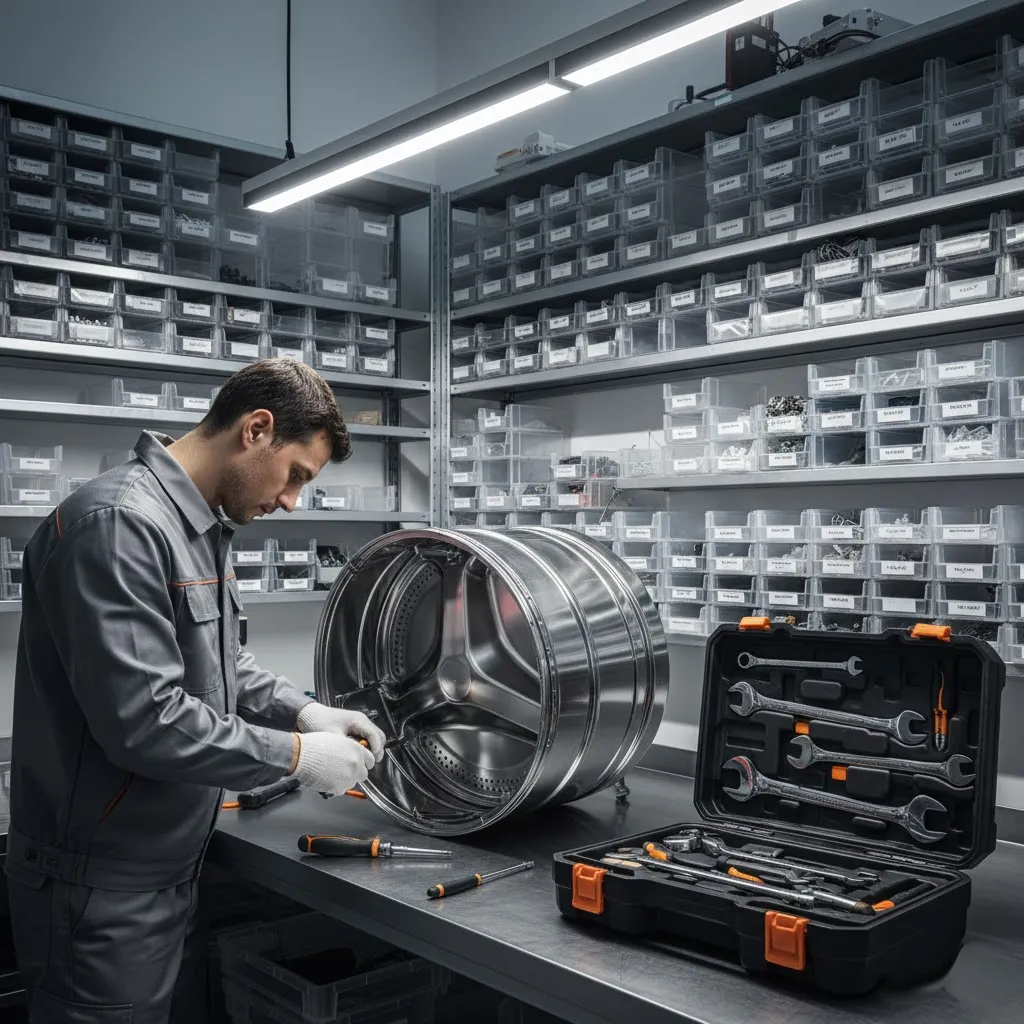
If the clothes stay wet, the drum turns slowly or has stopped altogether, the cause can be in one of two places: the motor and the mechanics that pass its power on to the drum, or the electronics that control the motor. The first step is to work out which one it is.
Mechanics or electronics
- The motor hums, but the drum doesn't move. Usually mechanical: the belt has come off, an object is stuck between the drum and the tub, a bearing has collapsed.
- The motor makes no sound at all. Usually electronic: the triac or relay that switches the motor on, the inverter driver, the wiring to the motor.
- The drum turns during the wash but not on the spin. The speed sensor signal, imbalance, or water not draining (the machine won't go into the spin while there is water inside).
- The drum jerks and stops. Imbalance or the speed sensor; in inverter machines — the rotor position sensor.
What we check in the electronics
| Part | What happens |
|---|
| Motor triac (in machines with a brushed motor) | It shorts or doesn't open — the motor doesn't run or turns out of control |
| Reversing relays | The drum turns only one way or not at all |
| Speed sensor (tachogenerator) input | The module doesn't know the drum speed — it won't go into the spin and shows an imbalance code |
| Inverter driver | The power module burns out — inverter motor |
| Water level sensor input | The module “thinks” there is water in the tub and, for safety, won't go into the spin |
Imbalance: if the code appears every time
Before the spin, the machine turns the drum to check whether the clothes are evenly distributed. A single duvet, a single pair of jeans or too few clothes create an imbalance, and the machine cancels the spin — this isn't a fault. Redistribute the clothes or change the load. If the code appears every time with a normal load (UB, UE on Samsung; UE on LG; UNB on Haier), the cause may be in the speed sensor signal or in the module input.
What you can check yourself
- If there is water left inside, first find out why it isn't draining — washing machine not draining.
- Unplug the machine and turn the drum by hand: it should turn easily, without any metallic noise.
- Distribute the clothes evenly, reduce the load and run the spin program on its own.
What we don't repair
Replacing the belt, bearings, drum, shock absorbers and the motor's carbon brushes is mechanical work and outside our scope. If diagnostics show that the cause is in these parts, we tell you.
Repair of the motor control electronics starts from 80 AZN. Codes — washing machine error codes, the module — washing machine board repair.
Main causes: a fault or the machine protecting itself
No spin doesn't always mean the washing machine is broken. Some of the main reasons the drum won't turn come down to the machine protecting itself: water has stayed in the tub, the door hasn't locked, the clothes haven't spread out evenly, there is too much foam, or the selected program doesn't include a spin. In these cases the module deliberately doesn't spin the drum up, and once the cause is removed, the machine works normally again. A fault looks different: it repeats whatever the load and the program, the motor either makes no sound at all or hums while the drum doesn't turn, and the same code appears on the display every time.
The easiest way to tell one from the other is to run the “spin” program on its own with an empty drum. If the empty drum picks up speed, the motor and its control are working — look for the cause in the load, the draining or the settings. If even the empty drum won't turn, go through the checks below; if they don't help, the fault is most likely in the motor, its drive or the electronics.
Spin mode and program settings
Before contacting a technician, look at the display and the selected program. Sometimes the machine is in perfect order, and it's just the settings that won't let it spin:
- The spin speed is set to zero, or “no spin” is selected. The machine drains the water but doesn't spin the drum up. Select the speed again with the spin button.
- The rinse hold option is on. On some models, with this option on, the machine stops after the last rinse without draining and waits for the next command. Finish the program with “drain” or “spin”.
- A delicate program is selected. Wool, silk and hand-wash programs spin very slowly or not at all — this isn't a fault. The night program on some machines also reduces or skips the final spin.
- There is too much foam. When it detects foam, the machine postpones the spin, adds a rinse and sometimes lengthens the program; some Samsung models show “Sud” on the display. The cause is usually too much detergent or a hand-wash powder.
An overloaded drum: how much laundry to load
An overloaded drum is one of the most common reasons for no spin. Before the spin, the machine tries to spread the clothes around the wall of the drum; if the drum is packed to the top, the clothes can't spread out, and after several attempts the machine cancels the spin or spins at low speed. Choose the load according to the program: the maximum weight in the manual usually refers to cotton, while for synthetics and delicates the limit is often half that or less. Wet laundry gets much heavier: duvets, towels and jeans soak up a lot of water. Load the drum so that there is room for your hand between the clothes and the top of the drum. In a machine that is overloaded all the time, the motor and its control — the triac or the inverter driver — are overloaded too.
The water won't drain or keeps coming in: pump filter, drain hose, inlet hose
While there is water in the tub, the machine won't go into the spin for safety reasons. The cause isn't only the pump — there are several points along the water's path:
- The pump filter. Coins, buttons, hair and bits of fabric clog the filter, and the water drains slowly or not at all. After cleaning, screw the filter in all the way: a filter that isn't fully closed leaks.
- The drain hose. The hose must not be kinked behind the machine or squashed against the wall. If its end is connected too low, the water flows out of the tub by itself (siphoning): the machine drains and refills and never gets to the spin. The correct height of the hose is given in the manual.
- The sewer connection and the sink trap. If the hose is connected to the sink trap, a clogged trap sends the water back, and the machine can't empty the tub.
- The inlet hose and the water valve. If the valve doesn't close fully, water keeps coming in through the inlet hose: the pump drains, the valve refills, the level sensor sees water in the tub, and the machine won't go into the spin. Switch the machine off, leave the tap open and watch the drum: if water flows into the switched-off machine, the valve itself isn't closing — turn the tap off.
If the filter and the hoses are fine, it's the electronics' turn. If the pump makes no sound, it may not be getting voltage from the module; if water keeps flowing only while the machine is running, the triac that controls the valve may have shorted. We restore these module outputs. Replacing the pump or the valve itself isn't our work; if the fault is there, we tell you plainly.
The door lock: the last check before the spin
The module turns the drum only when the door lock has locked and the confirming signal has arrived. If clothes are caught between the door and the seal, the lock doesn't fully engage and the program won't start. If the lock contact is worn, the signal can drop out during the wash: the machine stops the program and won't go into the spin, sometimes with a door code flashing on the display. In that case we check the electrical part of the lock, the triac that controls it and the module input. The door handle, hook and hinges are mechanical, and we don't repair them.
Turning the drum by hand: what it tells you
Turning the drum by hand is a simple but very telling check. Unplug the machine, open the door and turn the drum a few times in both directions:
- It turns easily and quietly. The mechanics are most likely fine; look for the cause in the settings, the draining or the electronics.
- It turns with a rumble, a rustle or a metallic noise. The bearings are worn. This is mechanical and not our work.
- It won't turn at all or sticks at one point. The drum is jammed: a foreign object has got in, or a bearing has collapsed.
- It turns too easily, with no resistance at all. On a belt-driven machine this often means the belt has come off: the motor runs, but the drum stays still.
- On an inverter (direct-drive) machine you feel a slight “stepped” resistance. That is the motor's magnets, and it's normal.
If a foreign object has got in
Coins, keys, hairpins or a bra underwire slip through the holes in the drum into the gap between the drum and the tub. Signs: jingling or knocking during the wash, the drum sticking, the water draining slowly. If you hear such a noise, stop the program and unplug the machine. Before washing, check the pockets, and wash bras and small items in a laundry bag.
- If the object has ended up in the pump filter, you can take it out yourself by opening the filter — this is the easiest case.
- If the object is stuck between the drum and the tub, the machine has to be partly dismantled to get it out, usually through the heater opening. This is mechanical work and outside our scope.
- Don't keep washing in this state. The object scratches the drum and can tear the door seal and jam the drum completely. Trying to turn a jammed drum, the motor and its control — the triac or the inverter driver — get overloaded and can burn out, and that is already an electronics repair.
The washing machine leaks water or smells of burning
These two signs are more serious than the lack of a spin: unplug the machine straight away, turn off the tap and don't switch it on again until the cause is known.
- Water is leaking. Many machines have a leak sensor in the base: when water collects there, the machine stops the program, pumps the water out and shows a code — E23 (F23) on Bosch and Siemens, LC (LE) on Samsung. That is why it never gets to the spin. The leak itself — a hose, the door seal, the pump — is mechanical and not our work; if water has got onto the module, we clean the corrosion off the board and restore it.
- A smell of burnt rubber. Most often the drum is jammed or turns stiffly, and the belt slips and heats up; worn carbon brushes also spark and give off a smell. This is mechanical.
- A smell of burnt plastic or an “electrical” smell. A triac or resistor in the module, or a wire or connector going to the motor, may have burnt out. This is electronics, and we repair it. If the circuit breaker trips when the machine is switched on, don't plug it in again until it has been checked.
What to tell us when you get in touch, and how the repair goes
The more precisely the technician knows the fault, the faster the diagnostics go. When you contact us, mention:
- Model and serial number. The label is usually on the inner door frame or on the back panel; take a photo of it.
- Where the machine stops. After the rinse, while draining or at the start of the spin; which code is on the display.
- The sound of the motor. It hums, gives a short jerk and goes quiet, or stays completely silent.
- The drum and the water in the tub. Whether the drum turns easily by hand, whether water stays inside, whether there was a leak or a burning smell.
- A short video. If you send a video of the fault on WhatsApp, the technician can give a preliminary assessment.
Diagnostics are paid: we check the module's outputs to the motor, the speed sensor and water level sensor inputs and, on inverter machines, the power section of the driver. Once we've found the faulty component, we tell you the cause, the price and the timing, and we start work only with your approval. After the repair we test the module under load: the motor turns in both directions, the speed sensor signal is read correctly and the spin works at different speeds. We give a warranty on the work done.

 Azərbaycan
 Русский
 English
 Türkçe