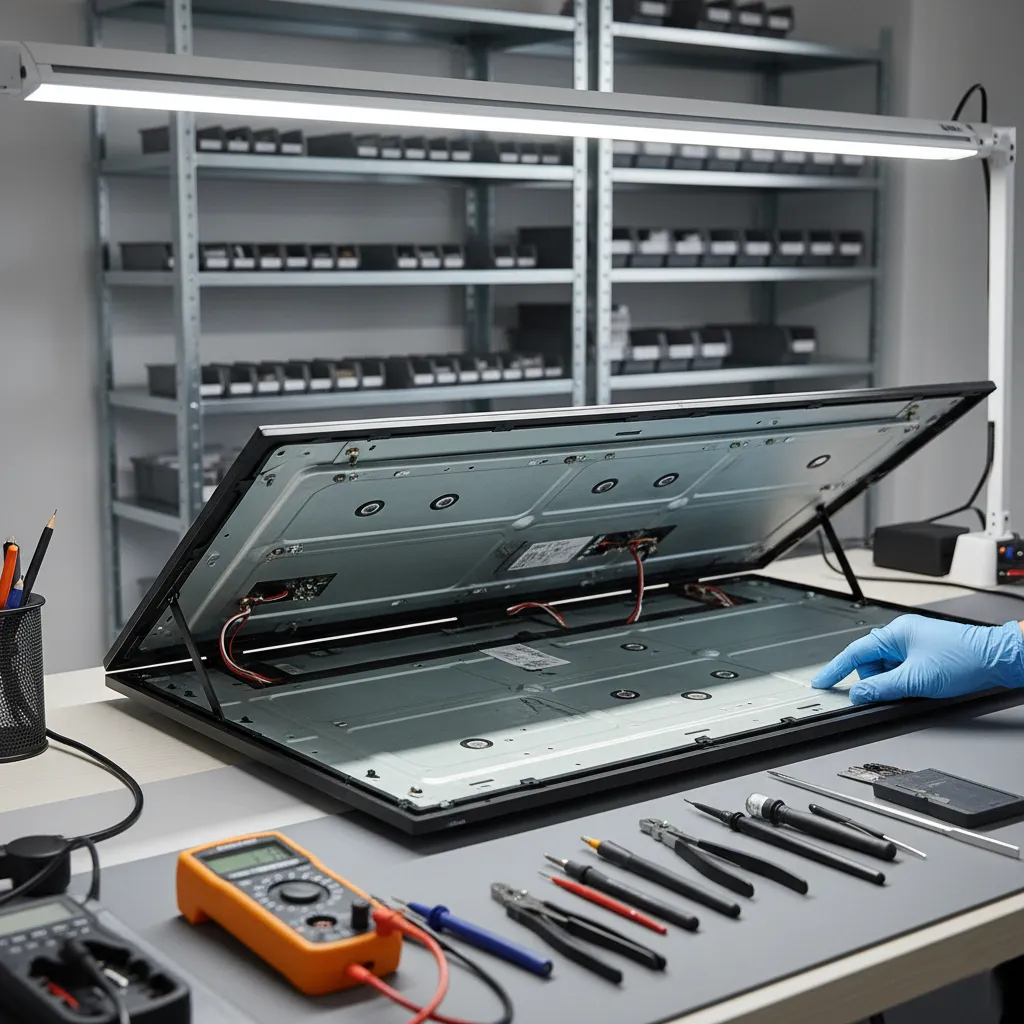
When something goes wrong with the screen, many people immediately think the panel has to be replaced. But some black screens, spots and lines are not caused by the panel itself — the fault is in the backlight, the T-Con board or the ribbon cable, and that repair costs much less than a new screen. That is why we first pin down which part is at fault and only then tell you the price.
What you see on the screen
- The screen is cracked, or there is a crack or a black spot where it was hit. The panel is damaged: it cannot be restored, only replaced.
- Sound but a black screen. Most often the backlight has failed while the panel is intact — LED backlight replacement is enough.
- Vertical lines — colored or white. The drivers along the edge of the panel or the ribbon cable. Sometimes the cable contact can be restored, sometimes the panel is replaced.
- Horizontal lines, half of the screen black, a doubled picture. The T-Con board or the panel drivers. If the T-Con is a separate board, it is repaired or replaced.
- Light spots, “circles”, one side dimmer. Lenses have fallen off the backlight LEDs or the diffuser has shifted — this is fixed without replacing the screen.
- Colors look like a negative, the picture flickers. The T-Con board, the ribbon cable or the signal coming from the main board.
The flashlight test
If there is sound but the screen is black, turn the TV on, darken the room and hold your phone's flashlight right up against the screen. If you see a faint image — a menu or a channel logo — the panel works and the fault is in the backlight. If nothing is visible, the cause may be the T-Con, the main board or the panel itself; diagnostics will show which.
Cracked screen replacement
A cracked panel, or one with internal impact damage, cannot be repaired. On a TV the glass is not replaced separately: the screen is a single panel made of several layers and is replaced as a whole. This requires a panel that fits that model — whether one can be found, and its price, depends on the model and the screen size.
The panel is the most expensive part of a TV. On large screens replacing it can approach the price of a new TV, so we quote the price in advance and you decide.
How the screen is replaced
- Confirming the fault. Diagnostics shows that the panel itself is damaged: the T-Con, ribbon cable and backlight are ruled out.
- Choosing a matching panel. The panel is selected not by the TV model code but by the panel's own code: the same TV model can have panels from different manufacturers — LG Display, BOE, CSOT, AUO. We open the TV and read the code from the panel label.
- Installation. The panel is carefully fitted, making sure no dust gets inside; the T-Con and ribbon cables are connected, and the backlight and diffuser go back in place.
- Testing. Test patterns are used to check for lines, dead pixels, colors and even illumination, then the TV is run for a long time.
Why screens crack and how to protect them
- Most screens crack from an impact: a thrown remote or game controller, a child's toy, the TV falling over. A TV mounted on the wall or secured to the stand with a special strap will not fall.
- When a TV is carried lying face down or on its back, the panel bends under its own weight and cracks from the inside: there may be no marks on the outside, but black spots and lines appear on the screen. Carry the TV upright, with two people.
- Do not press hard with your fingers when wiping the screen — the thin panel is damaged by pressure.
Your model's screen
Our catalog has pages for more than 9,500 TV models, listing the screen size, the panel type (VA, IPS, OLED) and the resolution. Enter your model code in the search below — this information helps us quote the screen price quickly.
OLED screens
An OLED TV has no backlight, so the “sound but no picture” symptom has a different cause here — most often the panel control board or the power supply. Permanent image retention (burn-in) is panel wear and cannot be fixed by repair; vertical lines are also usually in the panel itself. After diagnostics we tell you which option is possible.
Price
The cost of a screen repair depends on where the fault is: restoring the backlight, the T-Con or the ribbon cable is one cost, replacing the panel is quite another. Prices start from 60 AZN; more details — TV screen repair price.
We have described the typical screen faults of Samsung and LG TVs separately: Samsung TV repair and LG TV screen repair. A monitor screen works on the same principle — monitor repair.
Which TVs we repair
We repair TVs of every brand and type — LED, LCD, QLED, OLED, plasma and Smart TV: Sony, Panasonic, Samsung, LG, Philips and others. Repairs with a warranty are done at our service center: an experienced technician checks the screen, the backlight (we replace the LED backlight strips, not the whole TV) and the boards. A cracked TV screen is replaced; if water has got into the TV, the screen and boards are cleaned of corrosion and restored; lines on the screen most often come from the T-Con board or the ribbon cable. Writing Smart TV software is part of our job too — it is safer to trust your TV to a professional technician.
TV backlight not working: LED strips or the driver
If the backlight is not working, there is sound, and the flashlight test shows a faint picture. The fault can be in one of two places, and we separate them by measurement before quoting a price:
- LED strips. The LEDs on a strip are connected in series, so when one burns out, the whole chain goes dark. A typical sign: after switching on, the screen lights up for a second or two and then goes dark — the TV detects the fault and switches the backlight off.
- LED driver. It sits on the power board or on a separate board and feeds the strips with a stable current. If the strips test fine, the fault is in the driver, and we repair the board at component level.
The principle is the same on Samsung, LG, Xiaomi, TCL, Hisense and other LED TVs; what differs is the number of LEDs and the voltage of the strips, so new strips are matched not by the TV model but by the code printed on the old ones. We replace the strips as a full set and check the driver too: a faulty driver can burn out new LEDs as well.
A dark screen is not always the panel: often it is the backlight or the power board. TV diagnostics shows the real cause first.

 Azərbaycan
 Русский
 English
 Türkçe