
 Azərbaycan
 Русский
 English
 Türkçe

Repair or Replace Your Washing Machine?
When a washing machine repair pays off and when buying a new one makes more sense.
An electronics technician: module, board, inverter driver and error codes — finds the cause and restores the faulty part.
When you search for a “washing machine repair technician”, you often don't know which kind of technician you need. A washing machine has two different areas of work: mechanics — the drum, bearings, seal, belt, pump — and electronics — the control module (board), the power supply, the display panel, the inverter motor driver and the sensor control. The washing machine technicians at Innova Service specialise in electronics: they repair the machine's “brain”. All work is done at our service center, with measuring instruments and a test bench.
Electronics repair starts from 80 AZN. The technician first finds the cause, then tells you the exact price and timing; work starts only with your approval, and we give a warranty on the work done.
| What you see | Likely area |
|---|---|
| The machine won't turn on, the display stays dark, the indicators blink | Electronics: the module's power section, the button panel |
| The program stops halfway, a code appears on the display | Often electronics or a sensor; the code shows the direction |
| The water doesn't heat | Either: the heating element itself (mechanics), or its relay and the temperature sensor (electronics) |
| The drum doesn't turn, the motor makes no sound | Usually electronics: the motor driver, a triac, the speed sensor |
| The drum doesn't turn, but the motor hums | Usually mechanics: the belt, a stuck object, a bearing |
| Loud rumbling or a metallic noise while the drum turns | Mechanics: bearings, drum |
| Water leaks from under the machine | Usually mechanics: hose, seal, pump; overfilling, however, can also come from the electronics |
| The tap is open, but no water comes in or it keeps coming in non-stop | The valve and the triac that controls it (electronics), the water level sensor |
| The machine won't drain the water | Either: a clogged filter and the pump (mechanics), or the triac that controls the pump (electronics) |
We work on electronics. If diagnostics show that the cause is mechanical, we tell you openly — so that you don't spend money for nothing.
Some “faults” have a simple cause. Checking the following is safe and doesn't require opening the casing:
If there is a burning smell, the machine gives you an electric shock or the circuit breaker trips, unplug the machine immediately and don't start it again — this is a job for a technician.
If a technician suggests replacing the module, this is justified in the following cases: the board has been charred by fire and its base layer is damaged; most of the tracks have been destroyed by corrosion; the microcontroller has failed and its firmware cannot be found. In other cases — a burnt triac, relay, capacitor or power IC, a cracked solder joint — the module can be repaired. Either way, the technician should explain the cause and the reasoning behind the decision.
The model name helps the technician guess the fault in advance. On most front-loading machines the label is visible when you open the door — on the inner door frame or around the porthole; on some models it is on the back panel or behind the filter flap. On top-loading machines the label is usually under the lid. Write down the model name and the serial number from the label exactly as shown.
A washing machine module runs at high voltage, and it can't be repaired “by eye”. Our technicians work with an oscilloscope, a multimeter, a laboratory power supply, a soldering station and a programmer for memory chips. We test the module's load outputs under real load, so that after the repair the relays and triacs also work properly in the machine.
We work on the electronics of all brands. Each brand has its own specifics: the inverter drivers of Samsung and LG, the memory of Indesit and Hotpoint-Ariston modules, the coding of Bosch and Siemens modules, the code groups of Electrolux and Zanussi. More details: Samsung, LG, Indesit, Bosch, Beko, Electrolux.
First the technician finds out from you what happened: how the machine behaves, which code appears, whether there was a power cut or a water leak before the fault. Then they check the module, find the faulty part and tell you the price and timing of the repair. With your approval they carry out the repair, test the module under load and explain to you what was replaced. The general procedure is on the washing machine repair page, and what gets checked is on the washing machine diagnostics page.
The time depends on the fault: sometimes the faulty component is found and replaced quickly, and sometimes the required part has to be ordered, the data in memory restored, or the module put through a long test. That is why we don't guess the timing — we tell you exactly after diagnostics and start work only with your approval.
The more precisely the technician knows the fault, the faster the diagnostics go. When you contact us, mention the following:
A module rarely breaks “by itself”. More often an outside cause takes it out, and if the technician doesn't find that cause, the fault comes back:
How long the module lasts after the repair depends largely on how the machine is used. In buildings where the voltage often fluctuates, connect the machine through a stabiliser or a voltage relay. Plug the machine directly into an earthed socket, without extension leads or adapters. During a power cut, unplug the machine and plug it back in only once you are sure the supply is stable. After washing, leave the door and the detergent drawer ajar so that no damp stays inside; don't let water get onto the back of the machine or onto the control panel. Clean the drain filter regularly: a clogged filter loads the pump, which puts extra strain on the triac that controls it. If an error code keeps coming back, don't reset it and carry on washing — a small fault that isn't dealt with in time spreads to other parts of the module.
Repairing the electronics usually costs less than buying a new module, let alone a new machine. It pays off especially when the machine's mechanics — drum, bearings, door seal — are in good order and only the electronics are faulty; when the model is old and a new module can't be found on sale; when the fault appeared after a voltage surge and is limited to the power supply. If the repair isn't worth it — for example, the board is charred and the drum and bearings are worn as well — the technician says so plainly after the diagnostics, and the decision is yours. When deciding, weigh the machine's age, the state of its mechanics and the repair cost against the price of a new machine. Everything you need for that comparison — what is faulty, what will be replaced and the condition of the connected parts — the technician gives you in full after the diagnostics.
“The machine won't turn on at all” is the most common complaint a technician hears. The cause can be anywhere from the socket to the microcontroller, so the technician checks the chain in order:
Once the faulty component is found, the technician also looks for the reason it burned out — otherwise the new part will soon fail too.
Electronics repair starts from 80 AZN; the final price depends on the fault and the part needed — washing machine repair prices.
How to look after your washing machine to protect its electronics: clean the drain filter once a month, don't overload the drum, leave the door ajar after washing, and connect the machine through a stabiliser if the voltage in your home jumps.
Limescale doesn't damage the module directly, but it harms the parts the module controls, and the consequences end up on the board. That is why maintenance matters not only for the drum and the hoses:
Prevention is simple: dose the detergent according to the water hardness, from time to time run an empty hot wash with a descaling agent or citric acid as the manual says, and if the water is very hard, fit a softening filter on the inlet hose.
We also repair the electronics of Whirlpool, Miele, Vestel, Candy, Hyundai, Haier, Gorenje, Xiaomi, Hisense, Sharp, Panasonic and Toshiba washing machines. For less common brands and for machines bought abroad, a new module is often hard to find or takes a long time to arrive, so component-level repair is frequently the only way to keep the machine running. The order of the checks doesn't depend on the brand: the power supply, the load outputs, the sensor inputs and the motor driver. Brands differ in their error codes and in how their modules are built, so give us the full model name from the label and the code on the display — that way the technician knows in advance which module they will be working with.
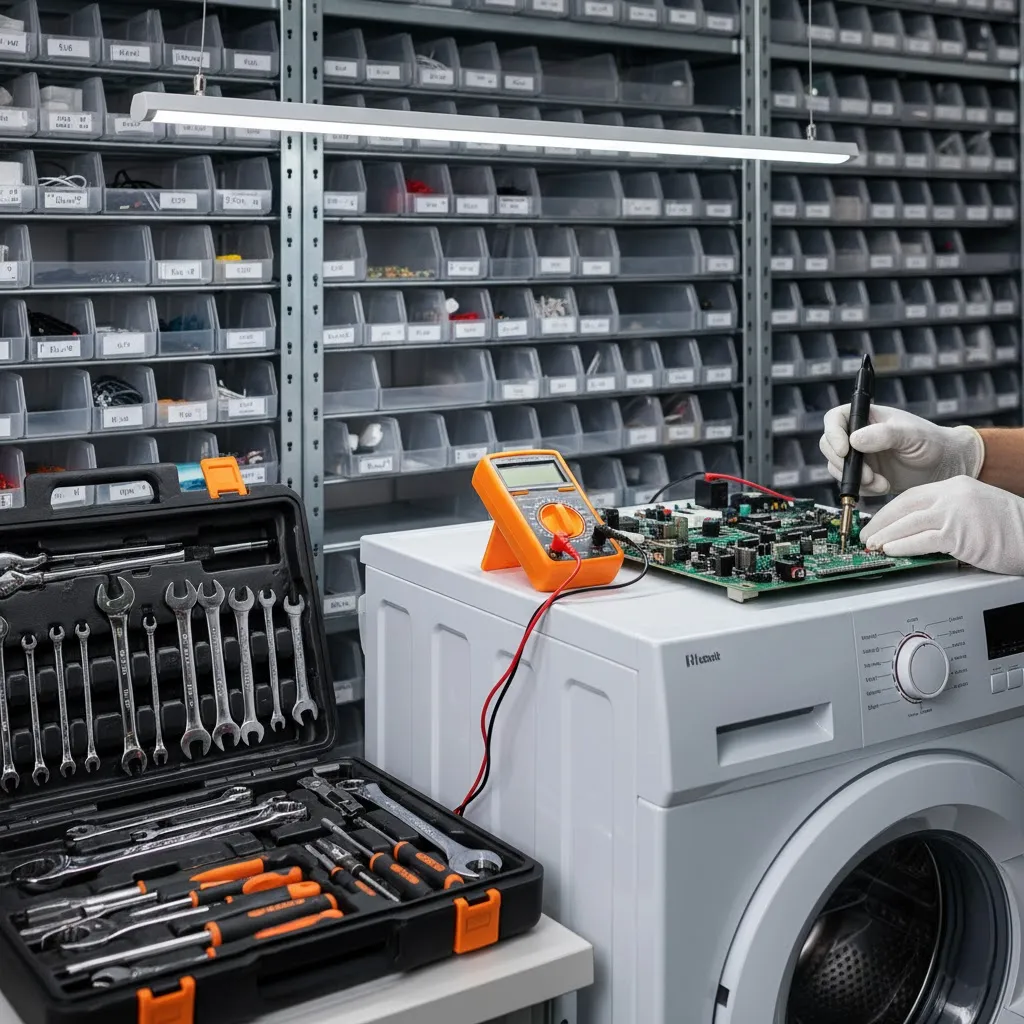
Choose your device and leave your number — we will contact you as soon as possible.
When a washing machine repair pays off and when buying a new one makes more sense.

Not every fault needs a repair: 8 simple checks before contacting a technician.
In today's fast-paced world, a broken washer can disrupt daily life. Finding an affordable washer repair service can be tricky, especially when seeking quality without hefty costs. This article explores practical strategies to maintain and repair your washing machine efficiently and economically.
The frustration of discovering your washing machine drum not spinning can disrupt your daily routine. Understanding the underlying causes is the first step toward a solution. Several factors might be at play, ranging from mechanical failures to user errors.
Have you ever found yourself staring perplexedly at a washing machine that refuses to drain? It’s a common inconvenience, but understanding the underlying causes can help you resolve it more efficiently. Let’s delve into why this might be happening and what steps you can take.

When your washing machine isn’t heating water, it’s not just an inconvenience—it can also affect the quality of your laundry. Understanding why your washer is not heating water is crucial in finding the right solution. Fortunately, most of the time, this problem can be diagnosed and resolved with a...
| Washing machine repair technician: electronics and module repair | from 80 AZN |
|---|
These are starting prices: we tell you the exact amount after diagnostics.
No. Our technicians specialise in electronics: the control module, power supply, display panel, inverter driver and sensor control. Replacing the drum, bearings, seal or pump is outside our scope.
Ask why. A module can often be restored at component level; replacement is needed only when the board has burnt through, its tracks have lifted off or the microcontroller has failed.
If the code keeps coming back, yes: a relay or triac that hasn't failed completely can throw errors now and then. If it isn't looked at in time, other parts of the module can be damaged too.
Electronics repair starts from 80 AZN. We tell you the exact price after finding the faulty part.
Yes, we give a warranty on the work done.
If the mechanics — drum, bearings, tub — are in good order, repairing the electronics is usually the better deal. A new module is hard to find for older models, while a component-level repair keeps the machine running. However, if the mechanics are worn or the cabinet has rusted through, buying a new machine makes more sense. After the diagnostics we tell you the repair price, and the decision is yours.
It protects against voltage surges and dips — the most common reason the module's power supply burns out. But it won't help against moisture, a shorted heater or a jammed pump, so keep an eye on the filter and keep the machine dry as well.
Common causes are an uneven load, transit bolts that were never removed, or worn bearings or shock absorbers. We check the mechanics during the diagnostics and tell you plainly; what we repair ourselves is the electronics — the module, the motor control, the sensors.
Check that the tap is open, the hose isn't kinked and the drain filter is clean. If everything is fine, the cause is in the valve, the pump or their control circuit on the module — the diagnostics will determine which.
Run an empty wash at 90 °C with citric acid or a cleaning product, clean the drain filter and the rubber door seal, and leave the door and the detergent drawer ajar after washing.
Message us on WhatsApp or give us a call. Tell us the model, the error code and what the machine does; a short video of the fault helps the technician make a preliminary assessment. Then we agree a time for diagnostics at our service center — we tell you the exact price after that.
1) Coins, keys and hairpins left in pockets — they fall between the drum and the tub or block the pump. 2) Underwired bras without a laundry bag — the wire can slip out and jam the drum. 3) Clothes with petrol, solvent or oil stains — their vapours can catch fire. 4) Rugs with a rubber backing — the crumbling rubber clogs the filter. 5) Items covered in pet hair — shake them out first, otherwise the hair ends up in the filter and the pump. 6) More detergent than the dose, or a hand-wash powder — the excess foam distorts the water level measurement and can spill over onto the electronics. 7) More laundry than the program allows — an overloaded drum strains the motor and its control. Following these rules protects both the mechanics and the module.
Leave your number — we will contact you as soon as possible