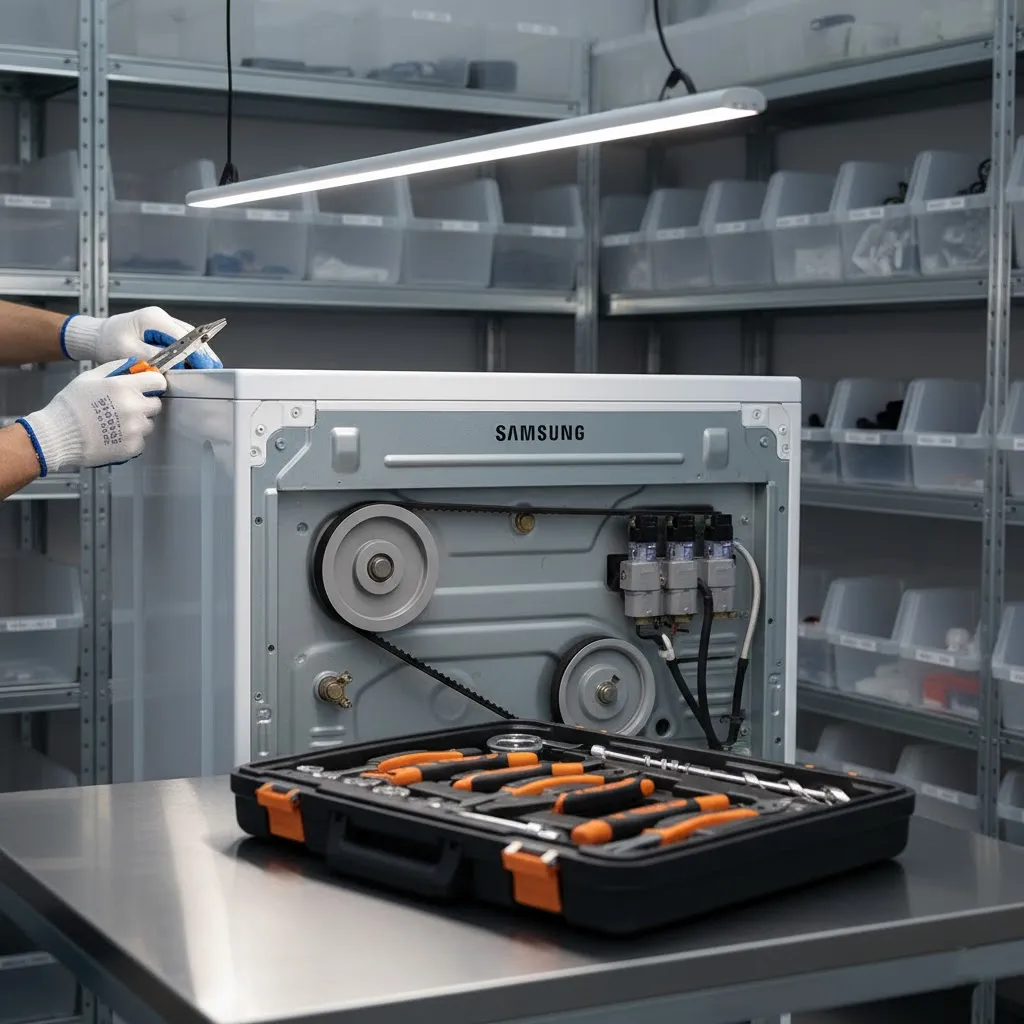
Most Samsung washing machines have a brushless inverter motor (Digital Inverter), controlled by the main board. In the Eco Bubble, AddWash, QuickDrive and other series, the electronics consist of two parts: the main board with the power section, and the display and button panel connected to it by a cable. We repair both at component level.
Typical electronic faults in Samsung machines
- The main board's power section. After the power goes off and comes back, the machine won't turn on or the display blinks.
- Inverter driver. The drum doesn't turn, the spin fails, 3C (3E) on the display — inverter motor.
- The link between the main board and the panel. Code AC (AE): the cable, the connector or the communication circuit of one of the boards.
- Valve and pump control. 4C (4E) — no water coming in, 5C (5E) — no draining, even though the tap is open and the filter is clean.
- Heating. HC (HE) — the heater relay or the temperature sensor input.
On newer models codes end in “C”, on older ones in “E”. A table of all codes — washing machine error codes.
How we repair
We check the main board and the panel and find the faulty component: the power IC, the power module, a triac, a relay or a component of the communication circuit. We replace it and test the board under load. For older Samsung models a new board is hard to find — a repair keeps the machine running. Electronics repair starts from 80 AZN. Mechanical work (replacing the drum, bearings, seal or pump) is outside our scope.
Other Samsung repairs: Samsung TV repair. All brands — washing machine repair.
Electronics features of different Samsung series
- Eco Bubble. The generator that mixes detergent with air and water to create foam is controlled by a separate output of the main board. If the generator doesn't work, the machine keeps washing but without foam — the cause is usually the control component on the board, a connector or a wire.
- AddWash. On models with a small hatch for adding laundry, the door lock and the contact that reports its state are checked by the main board. If there is no lock signal, the programme won't start and the display shows DC (DE).
- QuickDrive. The drum's movement is controlled by a complex algorithm, and the main load falls on the power module of the inverter driver. With the 3C code or a stop during the spin, this is the first thing we check.
- Washer-dryers (WD). The drying mode has its own heater, fan and temperature sensors. If washing works normally but drying doesn't, the cause is usually a relay in these circuits or a sensor input.
- SmartThings (Wi-Fi) models. The Wi-Fi module is powered by the main board and exchanges data with it. If the app can't see the machine, the network settings are checked first, then the module and its power supply.
Signs that point to an electronic fault
Some signs point straight to the electronics. If you notice one of them, don't keep trying to start the machine again and again: every new attempt loads the damaged component and can turn a small fault into a major repair.
- The display doesn't light up at all, even though the socket works.
- The buttons don't respond or the programme selection changes by itself.
- Switching the machine on trips the circuit breaker or the RCD in your flat.
- The programme stops halfway and the same code appears on the display again and again.
- The drum jerks in place but doesn't turn, or the spin doesn't reach speed.
- The water doesn't heat up and the laundry is washed in cold water.
- There is a burning smell from the machine or a dark mark is visible on the board.
A leak in itself is a mechanical problem — a hose, the rubber door seal, the pump housing — and we don't fix it. But if water has got onto the board, the electronics suffer: contacts oxidise, tracks corrode, and the machine won't turn on or shows false codes. We clean such a board and restore the damaged tracks and components; the leak itself has to be fixed by a mechanical technician, otherwise the problem will come back.
Other Samsung codes and their electronic causes
- 9C (9E, UC) — the mains voltage is below or above normal. If the voltage is fine, we check the board circuit that measures it.
- bE (bC) — a stuck button: a button on the panel, its contact or the panel itself. Most often caused by moisture getting under the panel.
- tC (tE) — the temperature sensor (thermistor): the sensor itself, its wire or its input on the board.
- 1C (1E, PE) — the water level sensor or the circuit through which the board reads it.
- OC (OE) — water overflow: the valve doesn't close, the level sensor reads wrong or the triac controlling the valve has stayed open.
- LC (LE) — water detected under the machine or a draining problem: first the place of the leak, then the sensor and its circuit.
- dC (dE) — the door lock doesn't close or the board doesn't receive the lock signal.
- Ub (UE) — unbalanced load: the laundry has bunched up on one side. If the code appears with an empty or half-loaded drum too, we check the speed signal and the driver.
The same code can have different causes, so buying a board or replacing a sensor based on the code alone is a mistake. Measurement comes first, and only the component that has actually failed is replaced.
Repair stages
- Intake. We take in your Samsung washing machine at our office and note the description of the fault and the code on the display.
- Diagnostics. We measure the main board and the panel and check the sensors, the valve, the pump and the motor circuit. The diagnostics are paid.
- Agreement. We tell you what has failed, what will be replaced and what it costs; we start the repair only with your consent.
- Component repair. We replace the faulty component, restore damaged tracks and redo cracked solder joints.
- Testing. We test the board in the machine under load: water intake, heating, washing, draining and spinning.
- Handover. We return the machine with an explanation of the work done and a warranty.
The Digital Inverter motor and the role of the driver
Samsung's brushless motor isn't connected to the mains directly. The driver on the main board converts the mains voltage into DC and then, through the power module, sends pulses to the motor's three windings in turn. The rotation speed and direction are set by the frequency of these pulses, and the board learns the rotor position from the current in the windings or from a sensor. That is why, when the drum won't turn or the spin won't reach speed, the fault is usually not in the motor but in the driver: the power module, its supply, the current-sensing resistors or the capacitors. We measure the resistance of the motor windings and check the insulation: if the windings are healthy, repairing the driver gets the drum turning again. If a winding is open or shorted, we say so plainly — that is a fault of the motor itself.
A driver failure is often triggered by an external cause. When the drum is overloaded, a foreign object gets between the drum and the tub, or a bearing turns stiffly, the motor draws more current, and the power module overheats and eventually fails. So after repairing the driver we turn the drum by hand: it should rotate easily and quietly. If the drum turns stiffly, the mechanical cause has to be removed first — otherwise even a new module will soon burn out.
When a board repair pays off
The Samsung main board is the most expensive electronic part of the machine. A new board can't be found for every model, and when it can, it means a long wait and a high price. A component-level repair replaces only the failed component — the power IC, a triac, a relay, the power module — and the rest of the board works as before. If the board is badly damaged by fire or water, we say so openly at the diagnostics and decide together with you whether a repair makes sense. If the motor, drum or bearing has failed completely, an electronics repair won't save the machine — we warn you about this in advance too, so you don't spend money for nothing.
How to protect the electronics of a Samsung machine
- Voltage. If the power often goes off or the voltage fluctuates, connect the machine through a stabiliser or a voltage relay: most power supply faults come from exactly this.
- Earthing. An earthed socket matters both for safety and for stable operation of the board.
- Filter. Clean the pump filter regularly: a clogged filter loads the pump, which is extra load on the board component that controls it.
- Drum Clean. Run the drum self-cleaning programme at the interval given in the manual — it prevents odours and deposits.
- Humidity. After washing, leave the door and the detergent drawer ajar, and don't keep the machine in a damp, closed room — condensation corrodes the board.
- Code. When an error appears, write down the code or take a photo of it: this speeds up the diagnostics.
What to check before contacting the service
Some codes aren't faults but the result of an external cause. If no water comes in, check that the tap is open and the hose isn't kinked. If the water doesn't drain, clean the pump filter. If the machine won't turn on, test the socket with another appliance and plug the machine in directly, without an extension cord. With an imbalance code, spread the laundry evenly in the drum. If the code stays after all this, the problem is in the electronics — hand the machine over to our service and we will find the faulty component by measurement.
Service terms
Repairs are carried out only at our office; we don't offer a mobile service. Customers from all districts of Baku — Yasamal, Binagadi, Narimanov, Nasimi and others — deliver their machines to the service themselves. We don't sell spare parts separately: the replaced components are part of the repair and included in its price. The repair we offer covers only the electronics: the board, the panel, the driver, the sensors and their circuits. Such a repair is available for Eco Bubble, AddWash, QuickDrive and older series. Before delivering the machine, give us a call: we will listen to the code and the symptoms and tell you what you can check yourself and what needs the service.
We also repair washing machines of other brands: LG, Bosch, Hotpoint-Ariston, Beko. We also work with the electronic modules of dishwashers and refrigerators — dishwasher repair, refrigerator repair.
Price, warranty and turnaround
The repair price is agreed with you after the diagnostics, before any work begins; the diagnostics are paid. The price is transparent: you know in advance what is replaced and why, and there are no unexpected extras later. A warranty is given on all work, and its length depends on the type of repair. If the same fault comes back during the warranty period, we check it again and fix it. We carry out the repair in the shortest possible time and with care; after voltage surges we pay special attention to the power section.
Which Samsung devices we repair and what it costs: Samsung service in Baku.

 Azərbaycan
 Русский
 English
 Türkçe